


Ethanol with a negative carbon footprint and BECCS are making progress in Brazil.

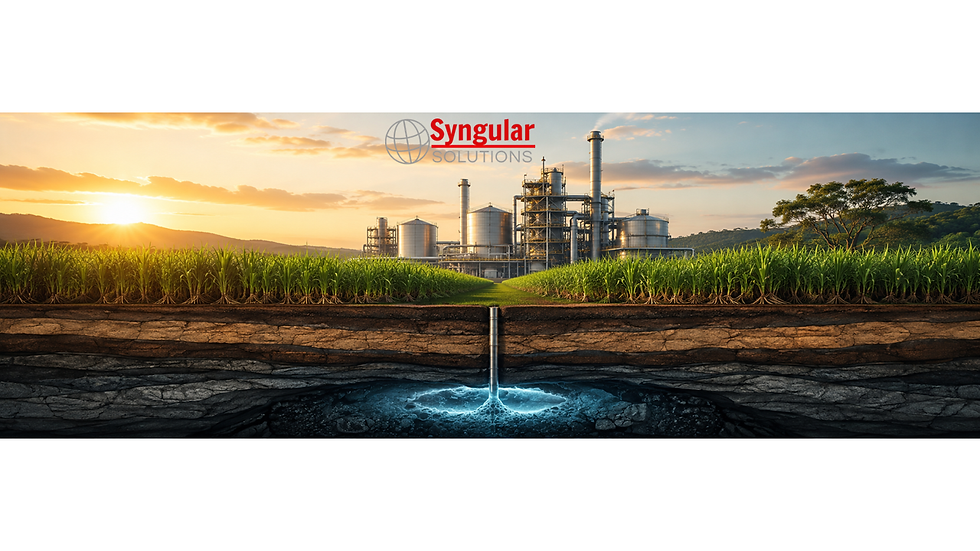
FS Fueling Sustainability has established itself as one of the pioneering companies in the development of carbon-negative ethanol solutions in Brazil, leading a strategic initiative that combines bioenergy, CO₂ capture, and permanent geological storage. The project developed in Lucas do Rio Verde (MT) represents a significant milestone for the energy transition, integrating industrial ethanol production with BECCS (Bioenergy with Carbon Capture and Storage) technologies on an operational scale.
According to publicly released information, the project foresees the capture of approximately 420,000 tons of CO₂ per year, with an estimated storage potential of about 12 million tons over approximately 30 years. Injection occurs in deep formations of the Parecis Basin, at a depth of approximately 1,100 meters, in geological reservoirs located below the industrial plant, reducing the need to transport CO₂ over long distances and increasing the operational efficiency of the system.

The geological location is one of the project's strategic factors. The Parecis Basin is considered a region with high potential for geological carbon storage, allowing for the integration of bioenergy production and permanent CO₂ storage within the same operational area. This model strengthens Brazil's competitive potential in the new low-carbon economy, especially through the combination of a renewable energy matrix, strong agro-industrial production, and favorable geological conditions.
In the case of ethanol, there is also an important operational advantage: during the fermentation process, the generated flow has a high concentration of CO₂ and a low level of contaminants, reducing the complexity of the capture steps when compared to other industrial segments. These characteristics contribute to the technical and economic viability of carbon-negative ethanol projects and open up space for new markets associated with the trading of carbon removal credits.
Syngular Solutions' Participation
BECCS projects require a high level of multidisciplinary integration, involving geophysics, geology, and petroleum engineering, including reservoir engineering, construction, completion and well testing, as well as operational safety, dynamic modeling, monitoring, and regulatory compliance. In this context, Syngular Solutions has been directly involved in the technical development of the project, working on different fronts of planning, execution, supervision, operational performance, safety, and regulatory management.
Syngular's involvement included the preparation of RFQs, support for contracting specialized services, well planning and execution, rig inspection, geological monitoring, monitoring of injectivity tests, reservoir simulation studies, performance analyses, integrity analyses, operational supervision, operational safety, and regulatory support with the ANP (Brazilian National Agency of Petroleum, Natural Gas and Biofuels).
In reservoir studies, geological, petrophysical, and dynamic information was integrated to represent the formations of interest and evaluate their behavior during CO₂ injection. Based on geological modeling, permeability and injectivity analysis, and dynamic simulations, it was possible to investigate different operational scenarios related to pressure response, reservoir connectivity, and CO₂ plume movement over time.
Beyond the technical studies, Syngular also provided operational support for the well, with teams responsible for daily drilling performance analysis, updating operational information, identifying productive and unproductive times, conducting benchmarks, and supporting decision-making. This support contributed to greater control over operational performance and better integration among the teams involved.
The operations also included rig supervisor engineers working directly in the field, monitoring activities in real time and supporting communication between drilling, geology, reservoir, and operational safety. In parallel, dedicated safety teams monitored critical activities, assessed risks, and verified safety conditions in the field, contributing to the prevention of incidents during operations.
In the regulatory area, Syngular participated in technical negotiations with the ANP (Brazilian National Agency of Petroleum, Natural Gas and Biofuels), including the preparation of documents, regulatory communications, organization of information, and participation in meetings related to project monitoring. This work contributed to ensuring traceability, technical consistency, and alignment with best practices applicable to the sector.
Projects of this nature also require continuous evaluation of operational robustness and the risks associated with the different stages of development. In this context, Syngular has been using ARM® (Advanced Risk Mitigation), a tool developed to support the integrated analysis of reservoir, drilling, and operational data, assisting in the identification of risks and the definition of mitigating actions throughout the project.
In addition to the steps already completed, Syngular is also participating in the development of the MMV (Monitoring, Measurement and Verification) Plan, fundamental for the long-term monitoring of geological CO₂ storage. This plan will be essential for monitoring reservoir behavior, tracking plume movement, and verifying the safety and permanence of stored carbon.
The progress of this project demonstrates that Brazil has the real potential to lead globally in solutions associated with bioenergy, CCS, and permanent carbon removal. It also highlights that the consolidation of this new chain will depend on the integration of innovative companies, specialized engineering, operational safety, technology, and regulatory management.

Comments